Can ESL Speaking Activities Improve Pronunciation? The Truth Revealed
Can ESL Speaking Activities Improve Pronunciation?
Do Speaking Activities Automatically Improve Pronunciation?
Speaking activities do not automatically improve pronunciation without specific focus and feedback. While general conversation practice enhances fluency and confidence, it can often reinforce existing pronunciation errors if they are not corrected. To truly improve pronunciation, speaking activities must be designed with explicit phonetic goals and include mechanisms for corrective feedback.
Many learners believe that simply "speaking more" will naturally smooth out their accent. However, research shows that adult learners often stop improving their pronunciation once they reach a "threshold of intelligibility" — meaning they are understood, even if their pronunciation is incorrect. This phenomenon, known as fossilization, requires targeted intervention rather than just more talking. Therefore, the answer is a nuanced "yes, but only if designed correctly."

The Cycle of Effective Pronunciation Improvement
How Do Specific Speaking Activities Target Errors?
Specific speaking activities target errors by isolating problem sounds and forcing the learner to notice the difference between their production and the correct model. Unlike free conversation, these activities control the vocabulary and structure to ensure the student focuses on the form of their speech (how they say it) rather than just the meaning (what they say).
For example, "Information Gap" activities can be designed so that success depends entirely on correctly pronouncing a minimal pair (e.g., "ship" vs. "sheep"). If the student mispronounces the vowel, the partner gets the wrong information. This creates an immediate, communicative need for accuracy. This type of "Noticing Hypothesis" application is crucial for breaking old habits and establishing new neural pathways for speech production.
What Are the Best Activities for Pronunciation?
The best activities for pronunciation combine focused listening with controlled production, such as Shadowing, Minimal Pair Drills, and Communicative Games. These methods bridge the gap between understanding a sound theoretically and producing it spontaneously in conversation.
1. The Shadowing Technique
Shadowing involves listening to a native speaker audio and repeating it simultaneously, aiming to match the speed, rhythm, and intonation exactly. This is one of the most effective activities because it bypasses the learner's internal "translation" process and builds physical muscle memory for English speech patterns.
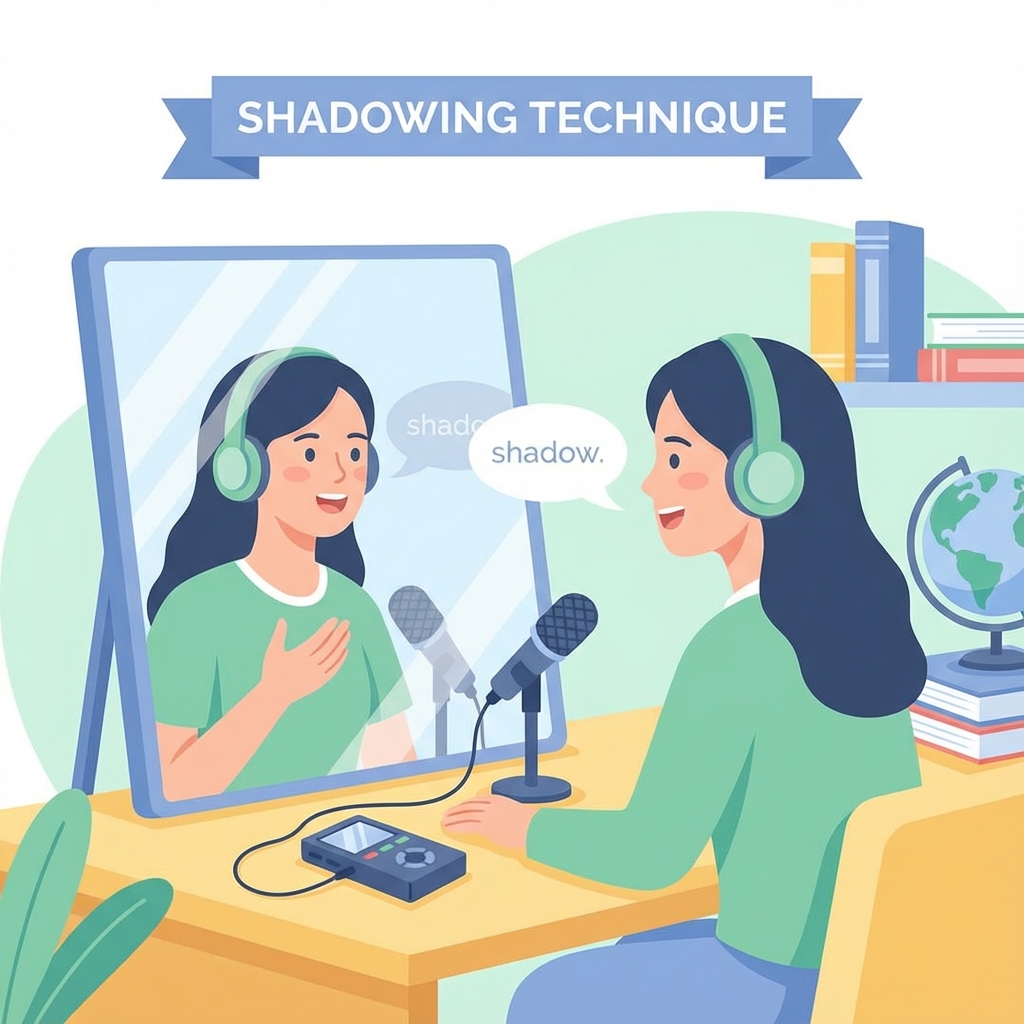
Shadowing: A Powerful Technique for Rhythm and Intonation
2. Minimal Pair Bingo
This game forces students to distinguish between similar sounds (like /l/ and /r/ or /b/ and /v/). Students have bingo cards with words like "light/right" or "berry/very". The teacher (or a student caller) says one word, and players mark it. This activity provides immediate feedback: if you have a line but the teacher didn't call those words, you know there was a perception error.
3. Mirror Work
Using a mirror allows students to visually check their mouth position. This is particularly useful for sounds like 'th' (/θ/ and /ð/), where the tongue position is visible. By comparing their mouth shape to a diagram or video of a native speaker, students can self-correct widely common errors before they become habits.
Does Conversation Practice Alone Reduce Accent?
Conversation practice alone rarely reduces a strong foreign accent because the primary goal of conversation is message transmission, not acoustic accuracy. During free speaking, the brain is occupied with grammar, vocabulary retrieval, and social dynamics, leaving little cognitive processing power for pronunciation monitoring.
Furthermore, polite listeners often "fill in the gaps" when they hear mispronounced words, meaning the speaker rarely gets the negative feedback needed to signal an error. To reduce an accent, learners need "Comparison time" — creating a recording of their own speech and comparing it side-by-side with a native model. This conscious analysis is what drives accent reduction, not just the act of speaking itself.
How Important Is Corrective Feedback?
Corrective feedback is the single most critical factor in converting a speaking activity into a pronunciation lesson. Without feedback, a student might repeat the same mistake thousands of times, effectively "practicing" the error until it is permanent. Feedback acts as the compass that redirects the learner's manufacturing process.
However, the timing of feedback matters. In accuracy-focused drills, immediate correction is best. In fluency activities, delayed correction (noting errors and reviewing them at the end) is preferred to avoid destroying the student's confidence. Teachers should focus on "high-value" errors—those that cause misunderstanding (intelligibility) rather than just striving for native-like perfection. For more on this, check out our guide on correcting common ESL pronunciation errors.
Further Reading and Resources
Improving pronunciation is a journey that involves both physical training and mental awareness. To explore more about teaching methods, consider reading:
- Teaching Pronunciation to ESL Students: A Complete Guide
- Creative ESL Speaking Activities for Adults
- AI Tools for Pronunciation Training
Useful Tools for Teachers
To support your pronunciation teaching, explore these resources:
- Dedicated Pronunciation Resources Library
- AI Lesson Planner - Generate pronunciation-focused lesson plans.
About the Author
Thomas Gueguen is a CELTA-certified English coach and the founder of The English Workshop. With over 12 years of teaching experience, he is an expert in TOEIC, IELTS, and TOEFL preparation, guiding students to a 98% success rate. Thomas is also the author of popular English learning guides, including "TOEIC - Le coach". He leverages his former corporate marketing background at companies like Bouygues and Veolia to help professionals use English to advance their careers.
Connect on LinkedInGet the Latest ESL Resources Delivered to Your Inbox
Join 10,000+ ESL teachers who receive our weekly newsletter featuring:
- Curated teaching materials and lesson plans
- Latest ESL tools and resources
- Teaching tips and best practices
- Exclusive content and early access to new resources
Related Articles
Continue learning with these related ESL teaching resources
Related Resources
Explore these hand-picked resources that complement this article
Learning Objectives:
- •Improve vocabulary retention
- •Practice grammar concepts
- +2 more objectives
Learning Objectives:
- •Create interactive digital assignments
- •Assess all four language skills
- +2 more objectives
New to ESL Teaching?
Check out our comprehensive glossary of ESL teaching terms and concepts.
Browse ESL Glossary