How Integrating Adult ESL Needs Into Primary Grammar Worksheets Enhances Learning for Both Age Groups
How Integrating Adult ESL Needs Into Primary Grammar Worksheets Enhances Learning for Both Age Groups
What Does Integrating Adult ESL Needs Into Primary Grammar Worksheets Mean?
Integrating adult ESL needs into primary grammar worksheets means adapting elementary-level English grammar materials to include content, contexts, and examples that resonate with adult life experiences while maintaining the foundational grammar concepts suitable for beginners. This integration creates versatile PDF resources that address the cognitive maturity of adult learners while preserving the systematic, scaffolded progression of primary-level grammar instruction. Primary grammar worksheets typically focus on basic structures like simple present tense, subject pronouns, and basic sentence formation, but when these worksheets incorporate adult-relevant contexts such as workplace scenarios, household management, or community participation, they become accessible to both children learning English and adult ESL learners who need foundational grammar skills. This approach recognizes that grammar proficiency levels do not correspond to age or intellectual capacity, and that many adult ESL learners require the same foundational instruction as primary students but delivered through age-appropriate content and examples.
Why Integrate Adult ESL Learner Needs With Primary-Level Grammar Materials?
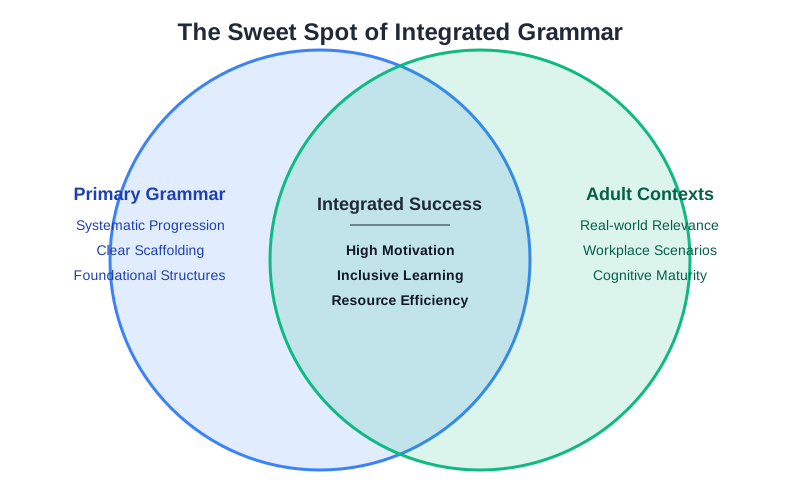
Integrating adult ESL learner needs with primary-level grammar materials addresses a critical gap in ESL education where adult beginners often feel infantilized by materials designed exclusively for children. Adult ESL learners frequently possess advanced cognitive abilities, life experience, and professional skills but lack English language proficiency, creating a unique educational challenge that standard primary materials fail to address. When teachers adapt primary grammar worksheets to include adult-relevant contexts, they validate the learner's maturity while providing the foundational instruction necessary for language acquisition. This integration also creates efficiency in resource development, allowing educators to maximize the utility of existing primary materials rather than creating entirely separate curricula for different age groups. Primary grammar worksheets typically offer excellent structural progression, clear explanations, and abundant practice opportunities, but their content often features children's interests like toys, playgrounds, and school settings that alienate adult learners. By maintaining the grammatical framework of primary materials while substituting adult-appropriate vocabulary and scenarios, educators create resources that serve both populations effectively. This approach also benefits primary learners by exposing them to broader vocabulary and real-world applications that extend beyond typical childhood contexts.
How Does Integrating Adult ESL Needs Benefit Primary-Level Students?
Integrating adult ESL needs into primary grammar worksheets benefits primary-level students by exposing them to authentic, real-world language applications that prepare them for future English use beyond the classroom. Primary students who engage with worksheets featuring adult contexts such as employment, civic participation, healthcare, and financial literacy develop broader vocabulary and cultural awareness that extends their language competence beyond typical age-restricted content. These integrated worksheets introduce primary learners to practical language functions they will eventually need as adults, creating a foundation for functional literacy that standard primary materials often neglect. Research in educational psychology demonstrates that children benefit from exposure to adult contexts when presented at appropriate linguistic complexity, as this exposure builds schema for future learning and demonstrates the practical value of language skills. Primary students working with integrated grammar worksheets develop enhanced motivation when they recognize that their language learning connects to meaningful adult activities and real-world communication needs. The varied contexts in integrated worksheets also provide richer input for language acquisition, offering primary learners multiple semantic fields and discourse patterns rather than limiting them to childhood-centric vocabulary domains. Additionally, integrated worksheets create more inclusive classroom environments where mixed-age or multi-level learners can work with the same materials, fostering peer learning and reducing the stigma that adult beginners might experience when using obviously child-oriented materials.
How Does This Integration Benefit Adult ESL Learners?
Integrating adult ESL needs into primary grammar worksheets benefits adult learners by providing age-appropriate content within a systematically structured grammatical framework that addresses their foundational language needs. Adult ESL learners frequently enter English language programs with gaps in basic grammar knowledge but possess mature cognitive abilities that enable them to understand complex concepts when presented clearly. These learners benefit from the systematic progression and scaffolded instruction characteristic of primary grammar materials, but they require content that reflects their life experiences, interests, and immediate communication needs. Integrated grammar worksheets allow adult learners to practice fundamental structures like subject-verb agreement, basic tenses, and sentence formation through contexts such as job applications, medical appointments, parent-teacher communications, and community interactions that directly relate to their daily lives. This relevance increases motivation, engagement, and retention because adult learners can immediately apply their grammar practice to authentic communication situations. Adult ESL learners also maintain their dignity and self-respect when working with materials that acknowledge their maturity, professional experience, and intellectual capacity rather than treating them as if they possess child-like cognitive abilities. The integration approach respects adult learning principles, including the need for autonomy, the importance of connecting new knowledge to existing experience, and the motivation that comes from solving real-world problems. Adult learners working with integrated grammar worksheets develop both linguistic competence and functional literacy simultaneously, acquiring grammar skills while learning to navigate essential life domains in English-speaking contexts.
What Grammar Topics Work Best for Integrated Teaching Across Age Groups?
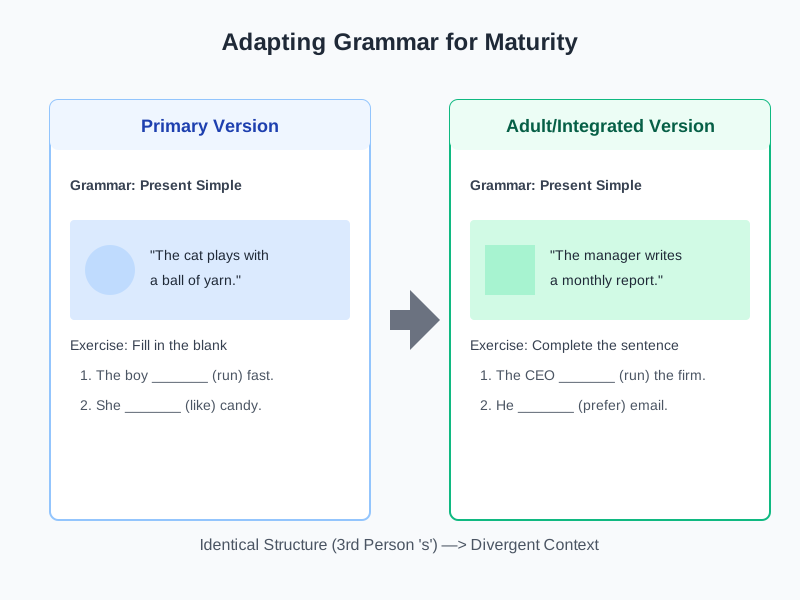
Grammar topics that work best for integrated teaching across age groups are fundamental structures that all learners need regardless of age, including subject pronouns, basic verb tenses, question formation, and simple sentence patterns. The simple present tense functions exceptionally well for integration because both primary students and adult ESL learners use it to describe routines, habits, and general truths, but the specific contexts can vary from "I brush my teeth" for children to "I work the night shift" for adults. Subject pronouns and possessive adjectives translate seamlessly across age groups because the grammatical concepts remain identical while the nouns they replace can reflect age-appropriate content. Question formation using "Wh-" words (who, what, where, when, why) serves both populations effectively, with primary worksheets featuring questions about school and play while adult versions address employment, housing, and civic participation. Basic prepositions of place and time work well in integrated materials because the spatial and temporal relationships they describe apply universally, though the contexts differ (prepositions describing playground locations for children versus workplace locations for adults). The present continuous tense for describing ongoing actions adapts easily across age groups, allowing primary students to practice with activities like "The girl is playing" while adult learners work with "The employee is filing documents." Modal verbs expressing ability (can/could), permission (may), and obligation (must/should) function as excellent integrated teaching topics because both children and adults need to express these functions, though the specific situations differ. Comparative and superlative adjectives work well for integration because the grammatical structure remains constant while the items being compared can reflect either childhood interests or adult concerns. The simple past tense serves both populations effectively...
How to Adapt Primary Grammar PDF Worksheets for Adult ESL Learners?
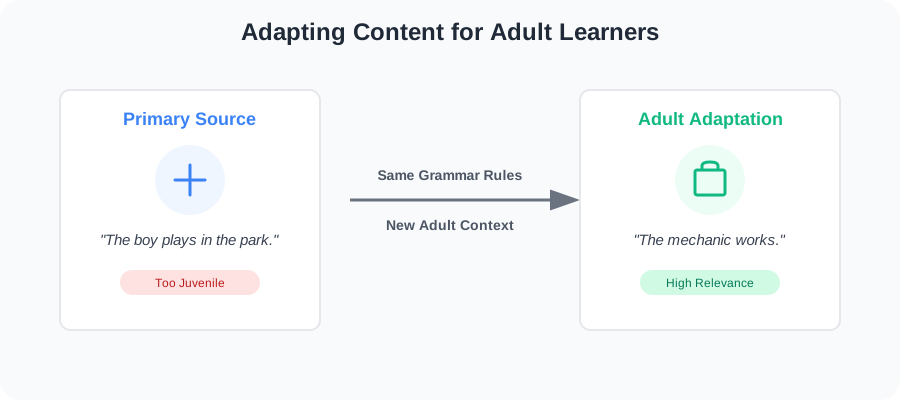
Adapting primary grammar PDF worksheets for adult ESL learners requires systematic modification of content, examples, and contexts while preserving the grammatical structure, progression, and instructional design of the original materials. Teachers should begin by analyzing the grammatical target of each worksheet to identify the core structure being taught, ensuring that this fundamental instruction remains unchanged during adaptation. The adaptation process then focuses on replacing child-centric vocabulary, examples, and scenarios with adult-appropriate alternatives that maintain equivalent grammatical complexity. For instance, a worksheet practicing simple present tense with sentences like "The boy plays with toys" can be adapted to "The mechanic fixes cars," maintaining the third-person singular verb conjugation while shifting the semantic content to adult contexts. Visual elements in primary worksheets, such as cartoon characters and playground scenes, should be replaced with photographs or simple illustrations depicting workplace environments, community settings, or household situations that adult learners encounter regularly. Instructions and directions on adapted worksheets should address adult learners respectfully, avoiding condescending language or oversimplified explanations that might insult mature learners' intelligence. Teachers adapting primary worksheets should also consider adding real-world application elements such as authentic forms, documents, or text types that adult learners will encounter in their daily lives while maintaining the grammatical focus of the original worksheet. The layout and design of adapted worksheets should maintain clarity and readability while appearing professional rather than juvenile, using appropriate fonts, spacing, and visual hierarchy that respects adult aesthetic preferences. Educators should also consider cultural and linguistic backgrounds of adult ESL learners when selecting replacement content, ensuring that...
Where to Find PDF Resources for Integrated ESL Grammar Teaching?
PDF resources for integrated ESL grammar teaching can be found through multiple channels, including ESL teacher resource websites, educational publishers, open educational resource repositories, and teacher-created material sharing platforms. ESLmaterials.org offers extensive collections of grammar worksheets suitable for adaptation, providing both primary-level materials and adult ESL resources that educators can use as templates for integrated instruction. Major educational publishers like Oxford University Press, Cambridge University Press, and Pearson produce grammar workbook series that include both young learner and adult editions, allowing teachers to compare parallel structures across age groups and create integrated versions. Open educational resource platforms such as OER Commons, MERLOT, and OpenStax provide free, openly-licensed grammar materials that teachers can legally modify and redistribute for integrated teaching purposes. Teacher resource sharing websites including Teachers Pay Teachers, ESL Printables, and BusyTeacher.org feature both free and premium grammar worksheets that educators can download in PDF format and adapt for mixed-age instruction. Government-funded adult education programs often provide free downloadable PDF materials, including USA Learns, California Distance Learning Project, and state-specific adult education resource centers that offer foundational grammar resources designed for adult ESL learners. Professional ESL teaching organizations like TESOL International Association and local TESOL affiliates maintain resource libraries with grammar materials suitable for various proficiency levels and age groups. Teachers can also access grammar worksheet generators and customizable templates that allow them to create original integrated materials by inputting specific vocabulary, scenarios, and contexts while maintaining consistent grammatical structures. Google Drive and Dropbox repositories shared by ESL teacher collaborative grou...
How to Implement Integrated Grammar Instruction in Mixed-Age Classrooms?
Implementing integrated grammar instruction in mixed-age classrooms requires careful planning, flexible grouping strategies, and differentiated materials that address the same grammatical concepts through age-appropriate contexts. Teachers should begin by identifying the core grammar objectives for each instructional unit, ensuring that all learners regardless of age will master the same fundamental structures. The implementation process involves creating or curating multiple versions of grammar worksheets that target identical grammatical forms but utilize different vocabulary domains, scenarios, and application contexts suitable for different age groups. In mixed-age classrooms, teachers can introduce grammar concepts through whole-class instruction that uses neutral examples applicable across ages, then transition to differentiated practice where primary students and adult learners work with age-appropriate versions of the same exercise. Flexible grouping allows teachers to sometimes group learners by age for content-specific work and other times by grammar proficiency level regardless of age, recognizing that grammatical competence does not correlate with age. Teachers implementing integrated instruction should explicitly explain to all learners that grammar structures function identically across contexts, helping students understand that different examples serve the same instructional purpose. Assessment strategies for integrated grammar instruction should evaluate grammatical accuracy and understanding rather than content knowledge, ensuring that primary students and adult learners demonstrate the same structural competence through their respective contexts. Classroom routines in integrated settings might include peer teaching opportunities where adult learners help younger students with problem-solving and organizational skills while primary students share cultural knowledge and enthusiasm that benefits adult learners. Technology integration through learning...
What Are the Research-Based Benefits of Integrated Grammar Instruction?
Research-based benefits of integrated grammar instruction include enhanced learner motivation, improved retention through meaningful contextualization, increased resource efficiency, and the development of more inclusive learning environments. Studies in second language acquisition demonstrate that learners of all ages benefit from grammar instruction that connects to their lived experiences and immediate communication needs, with adult learners showing significantly higher motivation and persistence when working with age-appropriate materials. Research on schema theory indicates that both children and adults acquire grammatical structures more effectively when new language connects to existing knowledge frameworks, supporting the integration approach that adapts content while maintaining structural consistency. Educational research on universal design for learning shows that materials designed to be accessible across diverse populations often benefit all learners by providing multiple representations, varied contexts, and flexible application opportunities. Studies examining cognitive load theory suggest that learners can dedicate more mental resources to acquiring grammatical structures when the content itself is familiar and relevant, rather than struggling with both new grammar and unfamiliar or inappropriate contexts. Research on adult learning theory, particularly andragogy, demonstrates that adult learners require autonomy, relevance, and respect for their experience, all of which integrated grammar materials can provide while maintaining the systematic instruction found in effective primary materials. Longitudinal studies of ESL programs indicate that learners who work with contextually relevant materials demonstrate better long-term retention and application of grammatical structures in authentic communication situations. Research on classroom climate and learner affect shows that adult ESL learners experience reduced anxiety and increased confidence when w...
Best Practices for Creating Integrated Grammar Worksheet Collections
Best practices for creating integrated grammar worksheet collections involve systematic planning, consistent formatting, clear labeling, and ongoing refinement based on learner feedback and outcomes. Teachers developing integrated collections should begin by mapping the grammatical scope and sequence they intend to cover, ensuring comprehensive coverage of essential structures from basic to advanced levels. The collection should include multiple versions of each grammatical concept with parallel structures but varied contexts, allowing educators to select age-appropriate versions while maintaining instructional consistency. Effective integrated worksheet collections feature clear labeling systems that identify both the grammatical target and the intended audience, enabling teachers to quickly locate appropriate materials for specific learners or groups. Best practice involves creating authentic, realistic contexts in adapted worksheets rather than artificially simple or contrived examples, ensuring that adult learners work with language they will actually encounter and use. Collections should include answer keys and teaching notes that explain the grammatical concepts, suggest implementation strategies, and identify common learner difficulties regardless of age group. Professional-quality formatting, consistent visual design, and careful editing demonstrate respect for all learners while ensuring materials appear credible and authoritative. Integrated worksheet collections should progress logically from receptive exercises that require recognition and comprehension to productive exercises that require generation and application of grammatical structures. Best practice includes incorporating various exercise types such as gap-fills, sentence transformations, error corrections, and communicative applications that address different learning styles and cognitive approaches. Teachers creating integrated collections should regularly solicit feedback from learners of diffe...
For more information on creating effective grammar materials, explore our comprehensive guide on teaching ESL grammar and discover how to create custom ESL worksheets.
Common Challenges in Integrated Grammar Instruction and Solutions
Common challenges in integrated grammar instruction include finding appropriate content for both age groups, managing different literacy levels, addressing varying background knowledge, and balancing grammatical accuracy with communicative competence. Teachers often struggle to identify contexts that feel authentic and relevant for both primary students and adult learners, but this challenge can be addressed by focusing on universal human experiences such as food, family, health, and community that resonate across ages while using age-appropriate vocabulary. The challenge of different literacy levels among adult ESL learners, some of whom may have limited formal education or literacy in their first language, requires incorporating visual supports, simplified instructions, and graduated difficulty that primary materials often include by design. Teachers face difficulties when adult learners possess extensive background knowledge that children lack, or conversely when primary students have technological or cultural familiarity that adult learners lack, but these differences can become assets through peer teaching and collaborative learning activities. The challenge of maintaining grammatical focus while providing meaningful content requires discipline in worksheet design, ensuring that adaptations preserve the grammatical structure and complexity of original materials rather than inadvertently simplifying or complicating the target structures. Teachers implementing integrated instruction often encounter resistance from adult learners who initially perceive "primary-level" materials as insulting, but this challenge can be addressed through transparent communication about grammatical proficiency versus intellectual capacity and through ensuring all materials maintain adult-appropriate presentation. The challenge of limited time for material adaptation can be addressed through collaborative development where teachers share the work of creating integrated resources, build...
FAQ: Integrated ESL Grammar Teaching Questions
Can integrated worksheets really work for both children and adults?
Integrated worksheets work effectively for both children and adults when they maintain consistent grammatical targets while varying the semantic content and contexts. The grammatical structures that form the foundation of English remain constant regardless of learner age, but the examples, vocabulary, and application scenarios can be adapted to reflect age-appropriate interests and needs. Research demonstrates that learners of all ages acquire grammar through similar cognitive processes, though adults benefit from more explicit instruction and explanations that primary materials often provide.
What if adult learners feel insulted by primary-level materials?
Adult learners accept primary-level grammatical instruction when materials are presented professionally with age-appropriate content and when teachers clearly distinguish between grammatical proficiency and intellectual capacity. The key lies in adapting the context and presentation of materials while maintaining the instructional rigor and systematic progression that makes primary materials effective. Teachers should explicitly discuss with adult learners that grammar proficiency represents a specific skill domain separate from overall intelligence, education, or capability.
How long does it take to adapt existing primary worksheets?
Adapting existing primary worksheets for adult ESL use typically requires 15-30 minutes per worksheet depending on the complexity of modifications needed. Simple text substitutions where individual words are replaced with age-appropriate alternatives take minimal time, while more extensive adaptations involving image replacement, layout modification, and instruction rewriting require longer. Teachers become more efficient with practice, and building a collection of adapted materials represents an investment that pays dividends through repeated use across multiple teaching contexts.
Should I use the same assessment tools for both age groups?
Assessment tools for integrated grammar instruction should evaluate the same grammatical competencies across age groups while allowing for different content in production exercises. Multiple-choice, gap-fill, and error correction assessments can be identical or parallel across age groups, while writing prompts and speaking tasks should reflect age-appropriate scenarios. The assessment criteria should focus on grammatical accuracy, appropriate form usage, and structural understanding rather than content knowledge or vocabulary breadth.
What grammar concepts are too complex for integration?
Very few grammar concepts are inherently too complex for integration, though advanced structures like subjunctive mood, complex conditionals, and sophisticated discourse markers may require different instructional approaches for primary versus adult learners. The majority of foundational and intermediate grammar structures including all basic tenses, modal verbs, relative clauses, and passive voice can be effectively taught through integrated materials that adapt contexts while maintaining structural focus.
How do I organize mixed-age groups for grammar practice?
Organizing mixed-age groups for grammar practice can follow multiple models including ability-based grouping where learners with similar grammatical proficiency work together regardless of age, age-based grouping where children and adults work separately on parallel materials, and mixed grouping where diverse ages collaborate on shared grammatical concepts. The optimal organization depends on specific classroom dynamics, the particular grammar topic, and the activity type, with flexible grouping that varies across lessons often proving most effective.
Discover more teaching strategies in our guide to essential ESL teaching strategies for beginners and learn about personalizing ESL materials for adult learners.
Digital Tools for Creating Integrated Grammar Worksheets
Digital tools for creating integrated grammar worksheets enable efficient adaptation of existing materials and development of new resources that serve multiple age groups simultaneously. PDF editing software such as Adobe Acrobat Pro, Foxit PhantomPDF, and free alternatives like PDFescape allow teachers to modify existing worksheet PDFs by replacing text, substituting images, and adjusting formatting without recreating entire documents from scratch. Word processing programs including Microsoft Word, Google Docs, and LibreOffice Writer provide templates and formatting tools for creating professional-looking grammar worksheets that can be saved as PDFs and easily modified for different audiences. Graphic design platforms like Canva, Adobe Spark, and Crello offer worksheet templates with drag-and-drop functionality, enabling teachers without graphic design experience to create visually appealing materials that maintain professional presentation appropriate for adult learners. Grammar worksheet generators including Busy Teacher Worksheet Generator, English Grammar Worksheet Generator, and custom tools developed by educational publishers allow teachers to input specific vocabulary and contexts while maintaining consistent grammatical structures across multiple versions. Learning management systems such as Google Classroom, Canvas, and Moodle facilitate distribution of differentiated materials, allowing teachers to assign age-appropriate worksheet versions to different student groups within the same course. Cloud storage and collaboration tools including Google Drive, Dropbox, and Microsoft OneDrive enable teachers to build shared repositories of integrated materials that multiple educators can access, use, and contribute to over time. Screen capture and annotation tools allow teachers to take existing digital worksheets, mark them up with modifications, and create adapted versions quickly without extensive reformatting. Text replacement software and find-and-replace func...
Internal Linking and Related Resources
Educators implementing integrated grammar instruction benefit from comprehensive understanding of related ESL teaching approaches and materials. Our extensive collection of grammar resources includes ESL grammar worksheets for intermediate learners that can be adapted for both young and adult populations. Teachers working with adult beginners should explore our guide on ESL worksheets for adults which provides age-appropriate context suggestions. For those teaching primary-level students, our article on printable ESL worksheets for kids offers foundational materials suitable for adaptation. Understanding broader teaching strategies enhances integrated instruction implementation, as discussed in our comprehensive guide to engaging strategies for teaching grammar. Teachers seeking to create custom materials will find valuable guidance in how to create custom ESL worksheets. For educators working with mixed-ability groups, our article on comprehensive guide to ESL worksheets addresses differentiation strategies. Digital teaching contexts require specialized approaches covered in ESL worksheets for online teaching. Assessment considerations for integrated materials are explored in how to assess progress with ESL worksheets. Teachers can also access our best free ESL worksheets online collection and discover where to find free ESL worksheets for building integrated material libraries.
Conclusion: The Future of Integrated ESL Grammar Instruction
Integrating adult ESL needs into primary grammar worksheets represents a pedagogically sound, resource-efficient, and learner-centered approach that addresses the reality that grammatical proficiency exists independently from age, intellectual capacity, and educational background. This integration honors the cognitive maturity and life experience of adult learners while providing them with the systematic, scaffolded instruction that effective primary materials offer. As ESL education continues to evolve, the artificial separation between young learner and adult curricula based solely on age rather than proficiency level becomes increasingly difficult to justify when integrated approaches demonstrate clear benefits for both populations.
The future of ESL grammar instruction lies in universal design principles that create flexible, adaptable materials serving diverse learners across the full spectrum of ages, backgrounds, and proficiency levels. Technology facilitates this integration by enabling efficient material adaptation, personalized learning paths, and dynamic content modification that would have been impractical in purely print-based educational contexts. Teachers who develop expertise in integrated grammar instruction position themselves as versatile educators capable of serving diverse student populations with limited resources, a valuable skill in educational contexts worldwide.
The evidence from both research and practice demonstrates that grammar instruction effectiveness depends far more on relevance, contextualization, and learner engagement than on age-specific content. When teachers recognize that the same grammatical structures serve all learners regardless of age, they can focus energy on what truly matters: creating meaningful contexts, providing clear explanations, offering abundant practice opportunities, and connecting language learning to authentic communication needs.
For ESL educators committed to inclusive, effective instruction, integrated grammar worksheets represent not merely a resource adaptation technique but a philosophical stance that respects all learners' needs for age-appropriate content delivered through pedagogically sound methods. The investment in developing or adapting integrated materials pays dividends through increased learner motivation, improved outcomes, and the satisfaction of seeing both children and adults develop the grammatical competence necessary for confident English communication.
Continue exploring ESL teaching excellence through our best ESL teaching materials guide, discover how to create engaging ESL lesson plans, and access our complete collection of free ESL worksheets online. For additional support in adult ESL instruction, review our guides on creating engaging ESL lesson plans for adult learners and ultimate guide to ESL lesson plans for adults.
About the Author
Thomas Gueguen is a CELTA-certified English coach and the founder of The English Workshop. With over 12 years of teaching experience, he is an expert in TOEIC, IELTS, and TOEFL preparation, guiding students to a 98% success rate. Thomas is also the author of popular English learning guides, including "TOEIC - Le coach". He leverages his former corporate marketing background at companies like Bouygues and Veolia to help professionals use English to advance their careers.
Connect on LinkedInGet the Latest ESL Resources Delivered to Your Inbox
Join 10,000+ ESL teachers who receive our weekly newsletter featuring:
- Curated teaching materials and lesson plans
- Latest ESL tools and resources
- Teaching tips and best practices
- Exclusive content and early access to new resources
Related Articles
Continue learning with these related ESL teaching resources
Part of these learning paths:
Related Resources
Explore these hand-picked resources that complement this article
New to ESL Teaching?
Check out our comprehensive glossary of ESL teaching terms and concepts.
Browse ESL Glossary